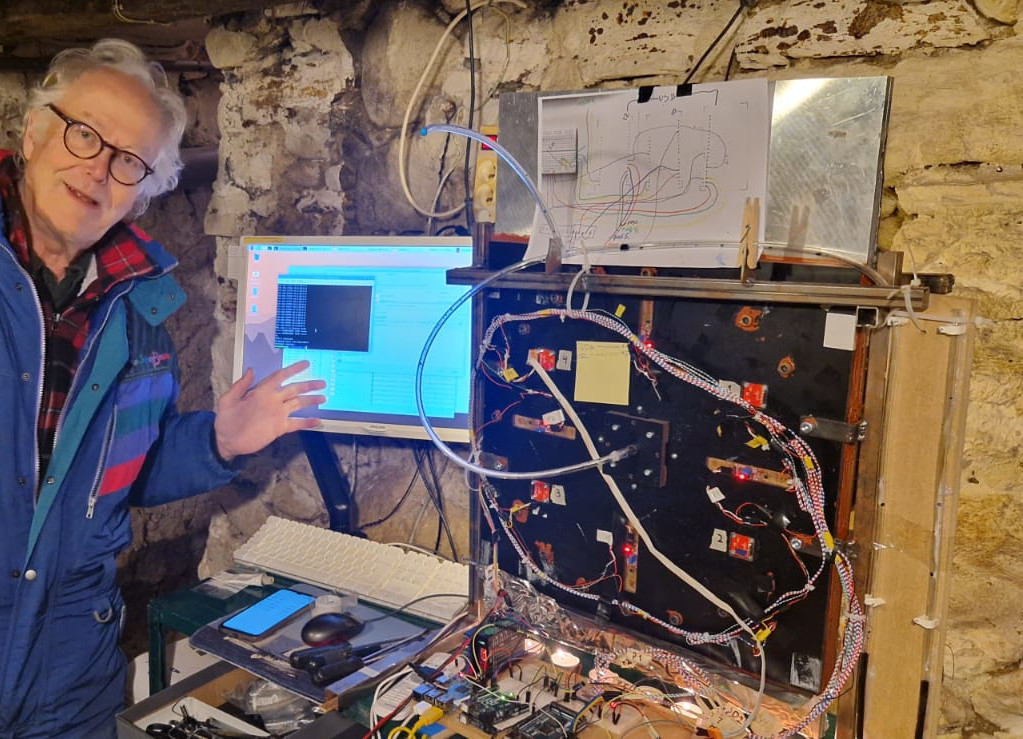
Spring 2026 GREC-LabModel v3 update in Candle Light test
π―οΈ From Low Quality Heat to Green Power β How Lab Models Proved The Thermodynamic Path
π₯ The Journey From Theoretical Idea to LabModel v3
The GREC Sustainability project aims to turn low-grade heat (like industrial exhaust,
geothermal energy, or solar heat) into clean electricity using an innovative thermodynamic Carnot
cycle. At the heart of this technology is the Work Generating Volume (WGV) β a rotating
chamber that cycles through hot, neutral, and cold zones in a continuous loop. By harnessing
pressure differences and heat transfer, the system generates mechanical work, which can then
be converted into electricity via a linear generator or similar mechanism.
This research has been a trial-and-error adventure, with each LabModel iteration helping us
refine our understanding of the physics at play. Below, we break down how early doubts were
either debunked or confirmed through experiments.
1. LabModel v1 "Woody": The First Reality Check
In the beginning, we had a theoretical model based on thermodynamics, fluid mechanics, and
heat transfer. But theory isnβt always reality β so we built LabModel v1 to test our boldest
assumptions:
β "Will the geometry actually work?"
Skeptics questioned whether the WGVβs alternating hot/cold zones could maintain
the necessary temperature and pressure gradients.
Result: β
The geometry worked as predicted, but we saw room for optimization β especially
in the "dead volume" (the non-working part of the system).
β "Does heat transfer happen fast enough?"
Worried that the Heat Transfer would be too slow to sustain an efficient cycle, especially at lower gradients.
Result: β
The experiment exceeded expectations β heat transfer was faster than predicted, the resulting
pressure showed by the connected Hygrommeter is the proof debunking this concern.
β New questions:
Results from the connected Hygrometer showed pressure variations related to speed. This opens for
different interpretations that implicates new questions:
β "Is the pressure distribution instant and uniform?" Theory says yes for a gas, but what is the reality?
β "Might the pressure waves in gas lag behind, creating inefficiencies?
Unfortunately the LabModel v1 broke down during a transport before we could test the assumption:
Pressure equalizes fast as the speed of sound in gas, meaning the system behaves almost instantaneously.
Key Takeaway:
LabModel v1 proved the basic physics worked, but left us with new questions about scaling, speed, and efficiency.
2. LabModel v2: Fine-Tuning the Physics
With v1βs positive results, we pushed further with LabModel v2, focusing on:
πΉ How do we scale this up? Can we build a full-sized system without losing efficiency?
β
Report indicates: The larger the better
πΉ Whatβs the best rotation speed? Too slow = weak heat transfer; too fast = energy waste?
β
Report indicates: Faster is better up to a certain rpm
π» CFD simulations β Using computer models to predict how different geometries affect pressure and heat flow.
β
Student groups reaches important conclusions on external and internal heat transfer using CFD.
What We Discovered:
π₯ HTC increases with speed β Faster rotation = better heat transfer, but with trade-offs (more energy loss).
π "Dead volume" is critical β Too much reduces efficiency; too little limits heat transfer.
New Questions Answered:
"Why did the experiment outperform expectations?" β Synergy effect! Faster heat transfer = more work output than predicted.
3. LabModel v3: Scaling Up & Searching the Sweet Spot
LabModel v3 was all about real-world viability:
- π§ Pressure lag β Was there any measurable delay in pressure equalization?
β
Experiments with pressure sensors in all temperature zones indicates:
β‘ Pressure equalizes instantly β No significant lag, even in large volumes.
- πΉ Measuring the right things β Were our sensors accurate enough to capture real-world behavior?
β
Hygrometer readings lags with revolution speed. Digital sensors shows instant pressure
- πΉ Trustworthy timing in measurements?
β
Yes! β Experiments evaluated hygrometer with digital sensors with speakers to confirm timing accuracy.
- βοΈ Optimal speed β How did rotation speed affect heat transfer and pressure dynamics?
β
Experiments show amplitute in certian speed intervals (1, 2 and 3 Hz) confirming assumptions.
Breakthrough Findings:
- π WGV size and geometry matters β Too small = weak heat transfer; too thick = weak pressure gradients.
- β±οΈ Pressure equalization is near-instant β No need to worry about delays, even in big systems.
- π Optimal speed exists β A balanced revolution rate maximizes both heat transfer and pressure dynamics.
The GREC LabModel v3 Update Will Facilitate Studies - Delivering Answers to Big Questions:
The update includes the foundation of a structured GREC documentation (git), like a widend repository:
πΉ containing the Revolving Dynamic Link system that controls and logs the GREC LabModel experiments,
complete with updates for:
πΉ latest Dynamic Link python code
πΉ html User Interface code
πΉ code for the I2C connected stepper motor control Arduino
πΉ code for the USB connected sensor control Arduino
πΉ scripts that will report status delivering YAML files "What has been done?", "How was it done?"
πΉ structure and naming well suited for automated or manual interaction with CFD and AI
The update will shorten setup and startup time for new studies:
β "Can we scale this technology?" β Yes! CFD will show the right WGV-to-dead-volume ratio. Today we assume scaling up is a win!
β "Whatβs the best revolving speed?" β A WGV geometry question β fast enough for heat transfer, but not so fast that it wastes energy.
β "How does the max and min amplitude angle travel with revolving speed?" β Experimental results
for extrapolations with CFD will be a breakthrough!
The Big Picture: From Doubt to Proof
Each LabModel version chipped away at uncertainties, turning "maybe it works" into "it definitely works."
This LabModel v3 update will add "how it performs"
Early Concern - LabModelβs Verdict
- "Heat transfer is too slow." - Faster than expected!
- "Pressure wonβt equalize fast enough." - Near-instantaneous.
- "The geometry wonβt hold up." - Works perfectly.
- "Scaling will ruin efficiency." - CFD proves itβs possible.
Whatβs Next?
Weβre not done yet! Future steps include:
π Large-scale prototypes β Testing in real-world environments (e.g., data centers, factories, geothermal plants).
π οΈ Material science β Finding the toughest sustainable materials to withstand heat and pressure.
π€ Smart control systems β Keeping the system running at peak efficiency automatically.
Final Thought: A Thermodynamic Revolution in the Making
What started as a theoretical hunch has now been proven in the lab β and the next step is changing
the world. By converting waste heat into clean power, this technology could help industries cut
emissions, save energy, and even power remote communities.
The journey from LabModel v1 to v3 delivered valuable general applicable studies and research,
wasn't just a building better machines exercise β it was research unlocking
the hidden physics that make this possible. And now? Even the future for low quality heat looks very hot. π₯